Toyo Car Talk · Toyota · Lexus · Honda · Subaru
Direct Injection and Carbon Buildup
Direct injection sends fuel straight into the cylinder instead of over the intake valves. That's great for power and mileage, but on engines with direct injection alone, nothing washes the backs of the intake valves, so carbon can build up and cause a rough idle and misfires. Many Toyota and Lexus engines use D-4S, which adds a port injector to help keep the valves cleaner. Honda and Subaru use direct injection on many engines and have their own service bulletins for carbon. If your engine is running rough, have it diagnosed first. Then you'll know whether it needs a cleaning or something else.
Does your vehicle need walnut carbon cleaning?Enter your year, make and model in our carbon buildup vehicle checker to see if your engine is the direct-injection-only type that builds carbon on the intake valves.
What is direct injection?
For decades, most gas engines used port injection. The injector sat in the intake, just ahead of the intake valve, and fuel mixed with the incoming air on its way into the cylinder.
A direct-injection engine moves the injector into the combustion chamber itself and delivers fuel at very high pressure, right where it burns. You'll see it called GDI, DI or "direct injection" on spec sheets. Putting fuel exactly where and when it's needed lets engineers meter it more precisely and get more power and better mileage out of a smaller engine. That's why Toyota, Lexus, Honda and Subaru all use it on many of today's engines.
Why carbon builds up on intake valves
Every engine lets a little oily vapor escape past the piston rings. The PCV (positive crankcase ventilation) system sends that vapor back into the intake so it gets burned instead of vented into the air, and some engines also feed a small amount of exhaust back in. Both pass right over the intake valves.
On a port-injected engine, fuel hits the backs of those valves all the time, and the detergents in gasoline keep them fairly clean. On an engine with direct injection only, the valves see air and that oily vapor, but no fuel. Over many miles, the residue bakes onto the hot valves and hardens into carbon.
A little carbon is normal. A lot can disturb the airflow into the cylinder and, in bad cases, keep a valve from sealing completely. That's when you start to feel it. Technicians writing in the trade press report that it builds up faster in low-speed, stop-and-go driving.
Direct only vs. dual injection: what's under your hood
Not every direct-injection engine is the same. The biggest difference for carbon buildup is whether the engine also has port injectors that wash the intake valves.
| Example engines | Injection type | What's on record | |
|---|---|---|---|
| Toyota & Lexus | 3.5L V6 in the Lexus IS 350 and GS 350; 3.5L V6 in the Tacoma (2016 and newer); 2.5L four-cylinder in the Camry and RAV4, gas and hybrid; the 2.0L boxer in the Toyota 86 and Subaru BRZ | D-4S: port and direct injection | Toyota built D-4S with two injectors per cylinder. On the 2016 Tacoma it also added a mode that cleans the direct injectors at hot idle. |
| Earlier Lexus | 2.5L V6 in the 2006 to 2010 IS 250 and IS 250C, and the 2006 GS 300 | Direct injection only | Lexus issued a bulletin and a support program for misfires and rough running that included decarbonizing the cylinder heads and valves. |
| Honda | 1.5L turbo in the Civic and CR-V; 1.5L in the 2016 to 2020 Fit; 3.5L V6 in the Odyssey, Pilot and Ridgeline | Direct injection | Honda has a bulletin for intake-valve carbon causing misfires on the 2016 to 2020 Fit, and extended the warranty on valve cleaning for some 2018 to 2019 Fits. |
| Subaru | Direct-injected boxer engines in the 2017+ Impreza, 2018+ Crosstrek, 2019+ Forester, 2020+ Legacy and Outback, Ascent and WRX | Direct injection | Subaru has bulletins with carbon-removal procedures, one using a chemical cleaner and a newer one using walnut-shell blasting. |
On a D-4S engine, the port injectors spray fuel over the intake valves during much of everyday driving, and the engine switches to direct injection alone when you ask for full power. That regular rinse is a big reason intake-valve carbon is less of a concern on these engines than on direct-only designs. Less of a concern isn't the same as never, though.
Not sure which kind of engine you have? Your owner's manual will tell you, or just ask us. It only takes a minute to look up.
What owners and technicians are seeing
- Rough idle and misfires on direct-only engines as the miles add up. Lexus, Honda and Subaru have all published service bulletins tying misfires or rough running to carbon deposits on certain direct-injected engines.
- Gas in the oil after very short trips. Honda updated the software and extended the warranty on some 2016 to 2018 Civic and 2017 to 2018 CR-V 1.5L turbo engines after oil dilution complaints. Honda said the problem was rare outside very cold climates.
- Recalls on high-pressure fuel parts. Lexus recalled certain 2006 to 2011 GS, IS and LS models for a fuel pressure sensor gasket that could leak, and certain RC F, GS F and LC 500 V8s for a high-pressure fuel pump part. Honda recalled some 2023 to 2025 hybrid models for high-pressure fuel pumps that could crack and leak. Recall repairs are free at the dealer, so check your VIN at nhtsa.gov/recalls.
- Not every misfire is carbon. Toyota has a bulletin for cold-start misfires on some 2.5L Camry, RAV4 and Avalon engines where the fix was a valvetrain part, not a cleaning. That's why we test before we recommend anything.
Signs of carbon buildup
Carbon builds up slowly, so the symptoms creep in. Watch for:
- A rough or shaky idle, especially right after a cold start or at a stoplight.
- Misfires, sometimes with a flashing or steady check engine light.
- Hesitation or stumbling when you press the gas.
- Less power and lower fuel economy than you're used to.
- On some Subarus, Subaru also lists black smoke from the exhaust and knocking or pinging.
A worn spark plug, a weak ignition coil, a vacuum leak or a bad injector can feel exactly the same. If your check engine light is on, our check engine light diagnosis is the place to start.
Phoenix driving and your engine
A lot of Valley driving is exactly the kind that trade technicians say is hardest on direct-injection engines: stop-and-go traffic, short errands around the neighborhood, and plenty of idling with the A/C running in drive-thru lines and school pickup.
Short trips also keep the engine oil from getting fully warm, which is what helps cook off moisture and fuel that sneak into the crankcase. You don't have to change how you live. Getting the car out for a longer drive at freeway speed now and then lets the engine get fully warm, and keeping up with maintenance does the rest.
How to keep a direct-injection engine healthy
- Use quality gasoline. Detergent gas helps keep injectors clean, and on a D-4S engine it also helps keep the port side and intake valves clean. AAA testing found TOP TIER gasoline left far fewer intake valve deposits than gas that just meets the minimum standard. On a direct-only engine, though, gas can't reach the intake valves at all.
- Change the oil on schedule, with the right oil. Use the viscosity and rating your owner's manual calls for. For turbocharged direct-injection engines, the current API SP rating adds protection against low-speed pre-ignition and timing chain wear. Fresh oil is also part of keeping deposits down. See our oil change page for more.
- Induction cleaning as preventive maintenance. A cleaner is fed into the engine's intake while it runs, following the maker's procedure. It dissolves light carbon before it has a chance to bake on and harden, so it works best done regularly, before there's a problem, rather than as a last-minute fix. Subaru's own bulletin uses this approach. Done wrong, it can harm turbos or throttle bodies, so it should be done carefully. We offer induction cleaning at ToyoMotors and do quite a few of them as preventive maintenance on direct-injection engines.
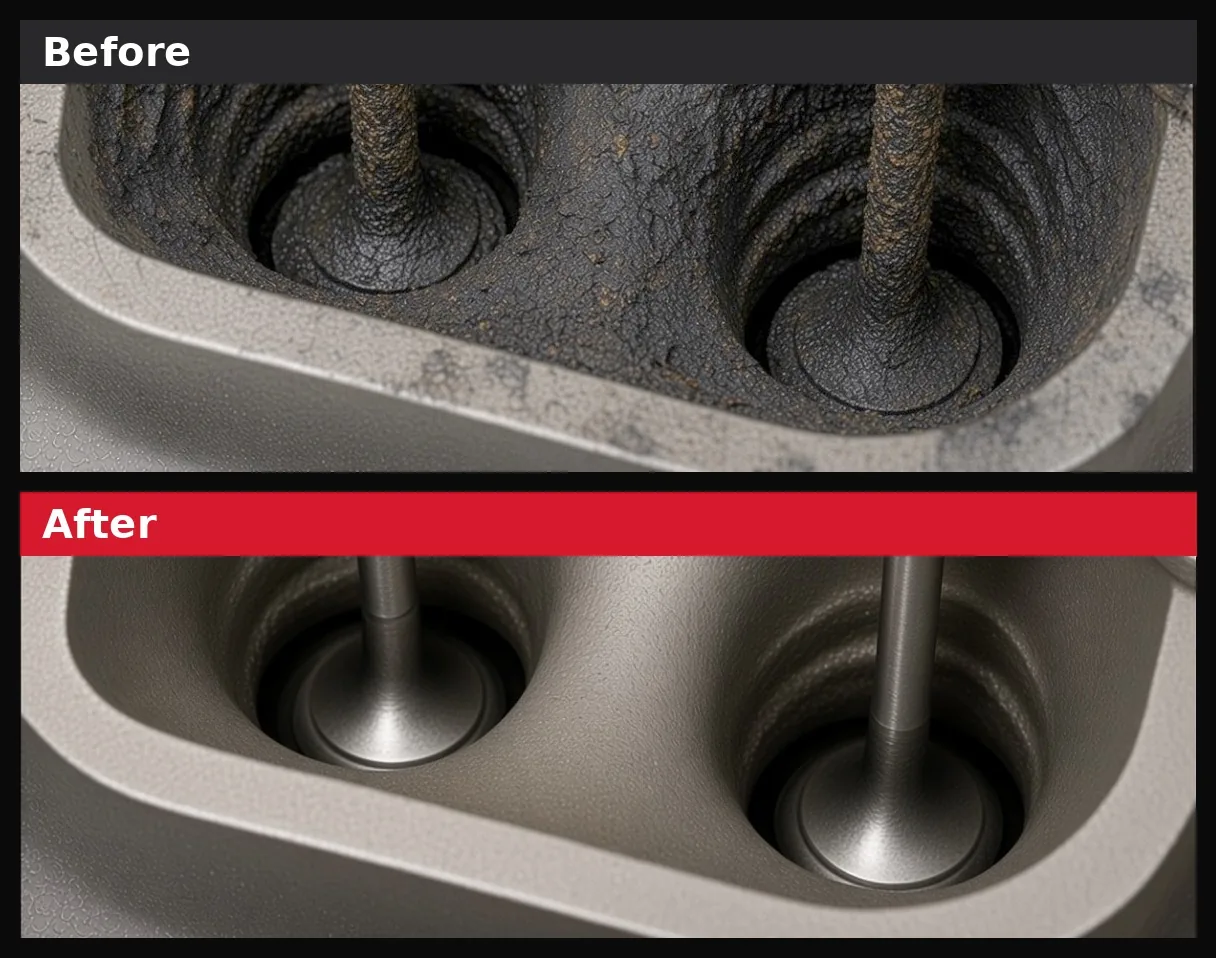
- Intake valve cleaning when deposits are heavy. When carbon is thick and hard, the intake manifold comes off and the valves are cleaned directly, usually by blasting them with crushed walnut shells and vacuuming the debris out. It takes more labor, but it physically removes the carbon and restores airflow. Subaru publishes a walnut-blast procedure for its engines.
- Injector testing and replacement. Direct injectors live inside the combustion chamber and work at very high pressure. If testing shows an injector is the cause of a misfire, replacing it is the fix, and no amount of cleaning will help.
The benefit of all this is simple: a smoother idle, better throttle response, mileage closer to what your car was rated for, and a much lower chance of a misfire turning into a bigger repair.
How we handle it at ToyoMotors
We've been working on Toyotas since 1979, and we take care of Lexus, Honda, Acura and Subaru owners too. When a direct-injection car comes in running rough, we start with a diagnosis, not a sales pitch. We read the codes and live data, check the ignition and injectors, and look at the intake side when the evidence points there. We also check for recalls and factory bulletins that might cover the repair.
We'd rather keep carbon from becoming a problem in the first place. That's why we offer induction cleaning as preventive maintenance on direct-injection engines, and we do quite a few of them. If the carbon is already thick and hard, the valves have to be cleaned directly, as described above.
Then we explain what we found in plain language and give you your options. If it just needs maintenance, we'll tell you that too. Learn more about our engine repair, Toyota, Lexus, Honda and Subaru service.
Vehicle checker
Does your vehicle need walnut carbon cleaning?
Pick your year, make and model, and the engine if you know it. We'll tell you whether your engine is the type that builds carbon on the intake valves, based on the factory bulletins and engine data in this article.
Your vehicleConfirm by VIN; engines can vary by trim and market. This checker is a guide, not a diagnosis.
Engine running rough or check engine light on? Start with check engine light diagnosis, or see our engine repair and auto maintenance pages.
Frequently asked questions
Do all Toyotas have direct injection?
No. Many newer Toyota and Lexus engines use D-4S, which has both a port injector and a direct injector for each cylinder. Some engines use port injection only, and a few earlier Lexus V6 engines, like the one in the 2006 to 2010 IS 250, used direct injection only. If you're not sure what your car has, ask us and we'll look it up.
Does Toyota's D-4S system prevent carbon buildup?
It helps a lot, but it isn't a guarantee. In everyday driving the port injectors spray fuel over the backs of the intake valves part of the time, which keeps them cleaner than on an engine with direct injection alone. Good fuel, on-time oil changes and a proper diagnosis when something feels off still matter.
Can a fuel additive clean the intake valves on a direct-injection engine?
Not on an engine that uses direct injection only, because the fuel never touches the intake valves. Detergent gasoline and additives can still help keep the injectors clean. To clean the valves themselves, the cleaner has to go in through the intake, which is how our induction cleaning works, or the valves have to be cleaned by hand or with walnut-shell blasting.
How often should intake valves be cleaned?
There isn't one interval that fits every car. Lexus, Honda and Subaru service bulletins treat carbon cleaning as a repair when there are symptoms such as misfires or a rough idle, and how fast carbon builds up depends on the engine and how the car is driven. If your engine is direct injection only and you notice symptoms, have it checked. To help keep carbon from building up in the first place, we offer induction cleaning as preventive maintenance on direct-injection engines. Ask us what makes sense for your engine and how you drive.
What are the signs of carbon buildup on intake valves?
The most common signs are a rough or shaky idle, misfires, especially right after a cold start, hesitation when you accelerate, less power, lower fuel economy and a check engine light. Other problems can cause the same symptoms, so the engine should be diagnosed before anyone recommends a cleaning.
Is gas getting into the oil a problem in Phoenix?
It's much less likely here. Honda's well-known fuel-in-oil issue on some 2016 to 2018 Civic and 2017 to 2018 CR-V 1.5L turbo engines mostly affected cars in very cold states driven on very short trips. Short trips can still keep oil from getting fully warm, so check your oil level and change it on schedule.